
Chinese Liberals: Japan's Useful Idiots Since 1937
TranslatED by Sun fY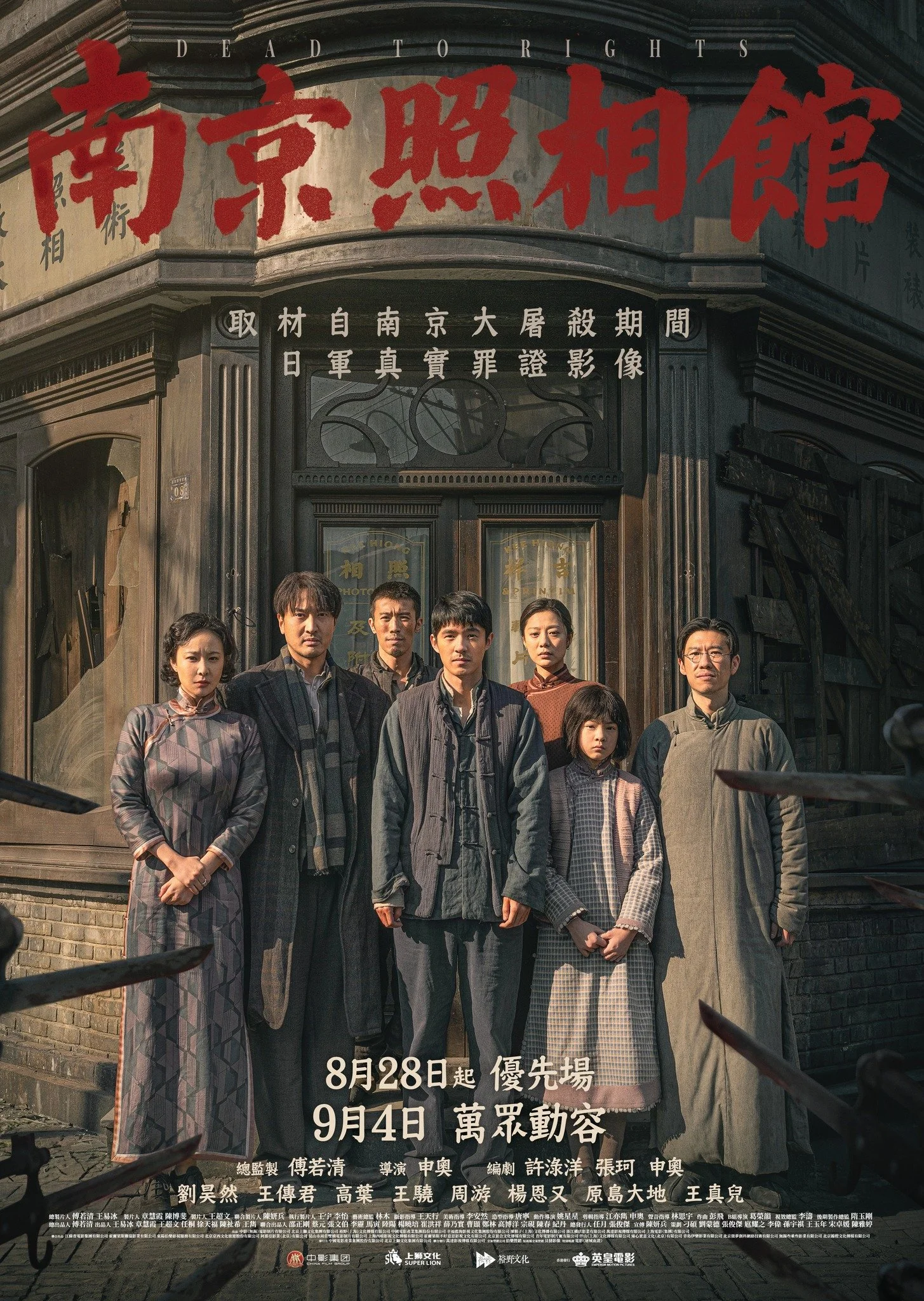
English-language Chinese media plays an important role in building an understanding of China. But many internal debates and discussions are often less visible without delving into native Chinese content. We are therefore pleased to publish an original translation by Sun FY of a Chinese-language piece by Ziwu (子午) on the communist internet forum Utopia, analyzing the phenomenon of self-hating, Japanophile Chinese liberalism through the lens of Dead to Rights.
Editor’s Note
On this day 88 years ago, December 13, 1937, the Imperial Japanese Army entered China’s pre-war capital of Nanjing. Over the ensuing six weeks, occupying troops unleashed an unspeakably brutal paroxysm of ritualistic mass slaughter and rape on the city’s defenseless civilian population. By the time it drew to a close, the Nanjing Massacre had claimed some 300,000 Chinese lives. It was arguably the single worst atrocity of the untold thousands perpetrated by Japan across China and the broader Asia-Pacific region during its 1931-45 wars of colonial conquest (preceded by its occupation of Ryukyu from 1879, Taiwan from 1895, and Korea from 1910 onwards).
In August 2025, a film dramatizing these events titled 南京照相馆 (lit. “Nanjing Photo Studio,” marketed in English as Dead to Rights) took the Chinese box office by storm. Its harrowing depiction of Imperial Japanese atrocities represented, in truth, just the tip of the iceberg of human depravity on display during the Nanjing Massacre – particularly when it came to sexual violence. The film nonetheless became a cultural centerpiece in China’s commemorations of the 80th anniversary of victory in the War of Resistance Against Japanese Aggression. Its overwhelming popular reception complemented the official spectacle of the September 3 Victory Day parade as well as the PRC’s first-ever formal celebration of Taiwan Retrocession Day on October 25.
These acts of historical remembrance have become exceptionally charged with the recent appointment of Sanae Takaichi as Prime Minister of Japan. Hailing from the far-right wing of the ruling Liberal Democratic Party, she has built her career on denying the country’s wartime atrocities and campaigning for remilitarization. In early November she asserted that Taiwan’s reunification with mainland China would represent a “survival-threatening contingency” for Japan, potentially justifying military intervention. These comments have triggered the worst diplomatic crisis between Japan and China in well over a decade.
One of China’s most high-profile countermeasures has been to issue multiple travel advisories regarding Japan, precipitating a wave of flight cancellations that threatens to wipe out some $1.2 billion in tourism revenue this year alone. The reason this constitutes such a potent threat is that mainland Chinese tourists account for a whopping 24% of foreign visitors to Japan. Outside observers may wonder at the seeming contradiction between the country’s popularity as a travel destination and the fraught memory of its wartime atrocities. The explanation boils down to class, as noted in the article we translate below. For Chinese liberals, traveling to Japan is a marker of class distinction, conspicuous consumption, and ostentatious “cosmopolitanism” in contrast to the narrow nationalism supposedly instilled by Dead to Rights and official commemorations of the War of Resistance.
English-language Chinese media plays an important role in building an understanding of China. But many internal debates and discussions are often less visible without delving into native Chinese content. This article by Ziwu (子午) is an illuminating take on the state of Chinese liberalism and its disdain for productions such as Dead to Rights. It is difficult to imagine anyone who would find a film about one of the worst war crimes of World War II objectionable, other than outright fascists and historical revisionists. But this is the position that many Chinese liberals find themselves in today. Originally published in August 2025 in Utopia (乌有之乡), a Chinese internet forum notable for its communist and occasionally Maoist leaning ideology, Ziwu’s critique links the Chinese liberal’s viewpoint to their class position, providing insight into the holistic Chinese liberal worldview.
Article Translation
Recently, with the release of films such as Dead to Rights, some netizens have been creating and circulating memes like: “Rich people’s kids go to Japan for summer vacation, poor people’s kids watch Dead to Rights for summer vacation.”
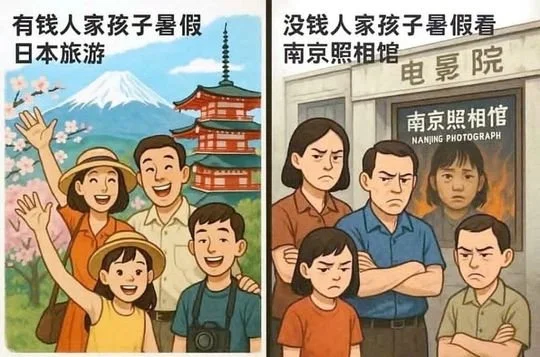
There’s also certain elements who ask in various Zhihu threads ”Did you take your child to see Dead to Rights?” as a form of loosely organized trolling.
It’s hard to believe the Japanese Ministry of Foreign Affairs isn’t spending money behind the scenes to generate this kind of “collective action.”The current Japanese right-wing government and its Foreign Ministry, as well as certain Japanese nationals who style themselves “anti-defeat”, are making a very elementary mistake in their propaganda: in their effort to spread these narratives, they are unconsciously claiming for themselves the monstrous crimes of Japanese militarism, further rallying hatred against themselves.
Although the storyline of Dead to Rights is an artistic interpretation, the atrocities of Japanese imperialism in massacring the Chinese people were real and far more brutal than any film portrayal—whether or not you choose to watch the movie.
Instead of working hard to sever ties with the crimes of Japanese militarism, the Japanese government is deceiving itself into thinking it can whitewash these crimes." This will only make the Chinese people question your present-day motives.
A few days ago, there was an “Old Beijinger” who came out angrily denouncing Dead to Rights, declaring that he wouldn’t watch it “even for ten thousand yuan.”


In his other videos, you find that he calls the Israeli butchers slaughtering defenseless Palestinian women and children “a great nation”, while urging the Chinese not to harbor “hatred or prejudice” toward the Japanese executioners who slaughtered their own compatriots. It’s clear where his true allegiances lie. At the same time, he heaps praise upon the corrupt, feeble Qing dynasty that let foreign powers trample China, while sneering at the other dynasties in Chinese history.
Could such a “Sino-Japanese friendship ambassador” really fool the Chinese people?
This is why I wrote in the title of this piece that Japan’s Ministry of Foreign Affairs is spending its money in the wrong places. It has backed a group of bad and foolish people to stir the pot—because the ministry itself is both bad and foolish.
Professor Dai Jinhua once said: “Discussing war history with Japanese scholars will turn me into a nationalist.”
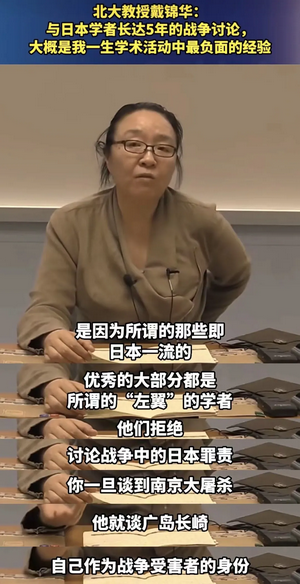
Caption: Professor Dai Jinhua shares her perspective on discussing war history with Japanese scholars and explains that “it’s because most of those so-called first-class Japanese ‘left wing’ academics refuse to discuss the crimes of Japan against China during the war. If you even mention the Rape of Nanjing, they will talk about Hiroshima and Nagasaki to claim the mantle of victim.”
I am not a nationalist. In fact, in earlier writings I opened myself to heavy criticism by highlighting the history of Japan’s anti-war movement, pointing out that ordinary Japanese people were also victims of war. Back then, I could not quite empathize with Professor Dai Jinhua’s words.
But today, seeing so many of the Foreign Ministry’s mercenaries stirring up trouble, I finally understood. I now despise not only these hired propagandists (including the unpaid “volunteers”), but the Japanese government and its Ministry of Foreign Affairs themselves.
Originally, my hatred was only for historical Japanese militarism. But through their actions today, they have succeeded in bringing that hatred upon themselves. Yet we must not fall into the trap set by today’s neo-fascists, allowing hatred to blind us.
Even though I already knew much about the Nanjing Massacre, when I saw those blood-red images on the screen, my heart was pierced with pain. It only strengthened my resolve that such tragedies must never be allowed to happen again, and I believe most kind-hearted Chinese people feel the same.
For the average Japanese person today, it is only by facing history honestly, empathizing with the suffering inflicted upon the Chinese, and thoroughly reflecting on the monstrous crimes of their forebears that they can avoid falling prey once again to the poison of new militarist forces and once again becoming tools of war.
Returning to that meme pushed by these propagandists — “Rich people’s kids go to Japan for summer vacation, poor people’s kids watch Dead to Rights for summer vacation.” — deeper problems emerge.
On one hand, it reflects a certain truth: there are indeed social differences and conflicts between the classes of “rich” and “poor.” Yet its conception of the “rich” is laughably shallow: the real “rich” are already investing in Japanese real estate and preparing to emigrate. On the other hand, it muddles the focus: instead of confronting the monstrous crimes of Japanese militarism—a fundamental moral question—it reduces everything to class envy.
This kind of conceptual sleight-of-hand reveals the petty-bourgeoisie’s extreme selfishness, arrogance, and prejudice against the poor. They link poverty with “low cognition, ignorance, even criminality”, similar to how they mock others with “The poorer you are, the more you care about national affairs,” or “The poorer you are, the more likely you are to be blinded by nationalist hatred and used as cannon fodder.” In doing so, they obscure the real cause-and-effect at play: “the rich” receive reward without labor while “the poor” labor without reward. And they also obscure the real roots of war, which lie in the actions of “the rich,” who incite and launch conflicts for their own gain.
Regarding the roots of war in the capitalist era, Marxism-Leninism has already given us a profound answer: the contradiction between the socialization of production and private ownership of the means of production inevitably leads to crises. Monopoly capitalism intensifies and deepens these crises. Severe economic crises exacerbate internal contradictions within imperialist states. To deflect from these crises and ease domestic contradictions, monopoly capitalists and their governments often resort to expansionism and military adventurism: seeking external markets, plundering resources, and launching wars as outlets for surplus capital and commodities.
Today, we are still in the era of global capitalism, and global economic crises have reached a new critical point. History’s tragedies could very well recur.
To prevent them, we must face history squarely, understand clearly the immense suffering war inflicted on the people, and grasp the roots of war so that we can solve the problem at its source.
Forget empty slogans like “Face history, cherish peace,” — the rallying cry “Workers of the world, unite!” is the one that has both truth and power.